

Mantis Botnet achter de grootste HTTPS DDoS-aanval gericht op Cloudflare-klanten

The botnet backside the largest HTTPS distributed denial-of-service (DDoS) attack in June 2022 has been linked to a spate of attacks aimed at nearly one,000 Cloudflare customers.
Calling the powerful botnet Mantis, the spider web operation and security company attributed it to more than 3,000 HTTP DDoS attacks confronting its users.
The most attacked industry verticals include internet and telecom, media, gaming, finance, business, and shopping, of which over twenty% of the attacks targeted U.S.-based companies, followed by Russia, Turkey, France, Poland, Ukraine, the U.K., Federal republic of germany, the netherlands, and Canada.
Last month, the company said information technology mitigated a record-breaking DDoS attack aimed at an unnamed customer website using its Free plan that peaked at 26 million requests per second (RPS), with each node generating approximately 5,200 RPS.
The tsunami of junk traffic lasted less than 30 seconds and generated more than 212 million HTTPS requests from more than one,500 networks in 121 countries, topped past Indonesia, the U.S., Brazil, Russia, and Bharat.
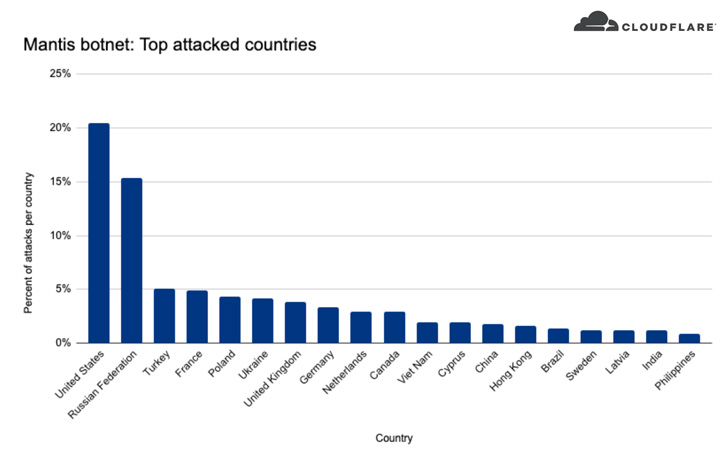
"The Mantis botnet operates a small fleet of approximately 5,000 bots, but with them can generate a massive strength — responsible for the largest HTTP DDoS attacks we have ever observed," Cloudflare's Omer Yoachimik said.
Mantis stands out for a number of reasons. The offset is its ability to behave out HTTPS DDoS attacks, which are expensive in nature due to the computational resources required to establish a secure TLS encrypted connection.
Secondly, unlike other traditional botnets that rely on IoT devices such as DVRs and routers, Mantis leverages hijacked virtual machines and powerful servers, equipping it with more resources.

These volumetric attacks aim to generate more traffic than the target can procedure, causing the victim to exhaust its resources. While adversaries have traditionally utilized UDP to launch amplification attacks, there has been a shift to newer TCP reflected amplification vectors that make utilize of middleboxes.
Microsoft, in May 2022, disclosed that it prevented about 175,000 UDP reflected amplification attacks over the past year that were aimed at its Azure infrastructure. Information technology likewise observed a TCP reflected amplification assault on an Azure resources in Asia that reached xxx meg packets per 2nd (pps) and lasted 15 minutes.
"Reflected amplification attacks are here to stay and pose a serious challenge for the internet customs," the Azure Networking Team noted. "They keep to evolve and exploit new vulnerabilities in protocols and software implementations to bypass conventional countermeasures."
Constitute this article interesting? Follow THN on Facebook, Twitter and LinkedIn to read more than exclusive content we mail.
Source: https://thehackernews.com/2022/07/mantis-botnet-behind-largest-https-ddos.html
Posted by: graylabsed.blogspot.com
0 Response to "Mantis Botnet achter de grootste HTTPS DDoS-aanval gericht op Cloudflare-klanten"
Post a Comment